Running two businesses: why Eden Flats made way for Eden Corporate Mobility
Running two businesses alone: why the founder of Eden Flats, an Airbnb concierge in the Paris region, focused on a B2B sister company, and how to choose.
Running two businesses alone works only while each one gets the time it needs. The founder of Eden Flats, an Airbnb concierge in the Paris region, chose to focus on a second company, Eden Corporate Mobility, a corporate housing agency: less time, fewer staff to manage, nothing to buy and clean, no flats to look after and bigger cheques. For a solo founder, I think it was a wise choice, even though Eden Flats’ new website was bringing calls from owners.
Running two businesses at once looks like two incomes. On the ground, it often means half the attention for each, and the first work to slip is the work nobody chases you for: the website, the SEO, the marketing. I saw a version of this with Eden Flats, an Airbnb concierge in Paris and the Île-de-France: first a website its founder had no time for, then a choice between two companies.
Its old website brought no leads. Then it was hacked, and the founder called me. I built a new site, did the SEO and the visual identity, and property owners started calling to have their flats managed. Even so, the founder chose to focus only on a second company, Eden Corporate Mobility, a corporate housing and mobility agency.
Below: what I built for each business, why I think stepping back from the one whose phone had started ringing was a wise move for a solo founder, and a checklist if you are weighing the same choice. This case sits alongside my Pilotech SEO case study, where a website built around one specific offer reached the top of Google.
Eden Flats: an Airbnb concierge whose website brought no leads
An Airbnb concierge like Eden Flats runs furnished flats as short- and medium-stay rentals for owners of second homes and rental properties. The list of jobs behind that sentence is long: listings on Airbnb, Booking.com and other platforms, prices that follow demand, choosing and welcoming guests, smart keys and lockboxes for remote check-in, cleaning after every departure, linen, and the upkeep of every flat.
The reason the old website brought nothing was simple: the founder had too many things to do to sit down and learn how SEO is done properly. When one person carries everything, the work that pays today comes first, and the website waits.
The hack is what brought me in. For a rescue like this, I answer the same day or within 24 hours: while a hacked site stays online, Google may show “This site may be hacked” in its results, and visitors keep away.
The rebuild: a new website, local SEO and a visual identity
I built Eden Flats a new website around the questions owners ask before they hand over their keys:
- What will you do for me? Pages on guest management, from choosing guests to welcoming them or letting them in remotely, and on property management, from cleaning after each stay to restocking supplies.
- How does it work? An FAQ on the platforms the flat is listed on, the services that can be chosen à la carte, how contracts and pricing work, and who keeps access to the Airbnb account.
- Do you cover my area? The home page lists the areas served, and town pages, such as Créteil and Saint-Maur-des-Fossés, present the service in each town.
- How do I reach you? A contact page with every way to get in touch, WhatsApp included.
The town pages are local SEO at its simplest. Owners look for a concierge close to their property, often typing the name of the town, so the site gives those searches a page that answers them. Each of these pages has to say something about the place itself: near-identical pages where only the town name changes can fall under what Google’s spam policies call doorway abuse.
The visual identity came with the site. On every project, I browse libraries for ideas, create an identity, show it to the client and adjust it if needed. For a concierge, the stakes are plain: owners are trusting you with their property, and a site that looks careless makes that a harder decision.
I have no figures to share for this one, only the change that mattered: once the new site, its SEO and the new identity were live, owners started calling to have their properties managed. The Eden Flats project page shows the site in more detail.
Running two businesses alone: why the founder chose Eden Corporate Mobility
Owners were calling, and the founder still decided to focus on the other business.
Eden Corporate Mobility works a bit like a travel management company for businesses. When a company sends staff to Paris or the Île-de-France, for a few nights or several months, the agency finds the housing (a furnished apartment, an aparthotel or a hotel), organises airport and station transfers and daily journeys, and arranges wellbeing services during the stay. The company has one contact and one quote, and its employees pay nothing up front.
Here is how the two businesses compare on the points that decided it:
| Eden Flats | Eden Corporate Mobility | |
|---|---|---|
| Clients | Owners of second homes and rental properties | Companies: HR teams, office managers, relocation agencies |
| Time it takes | More: every stay is prepared, welcomed and cleaned up after | Less |
| Staff to manage | More | Less |
| Things to buy and clean | Linen and supplies, for every stay | None |
| Property to look after | Every flat under management | None |
| Size of each sale | Smaller | Bigger cheques |
Eden Flats’ workload grows with every flat and every stay: more linen, more cleaning, more people, more things that can go wrong. In short-term rentals, the working day never quite ends; a guest who cannot open the lockbox is your problem, whatever the hour. Eden Corporate Mobility also deals in places to stay, but it does not run the flats, and it puts housing, transport and services on a single quote invoiced to the company.
I think it was a wise decision for a solo founder. When you are on your own, the business to keep is not the one with the most enquiries. It is the one where each hour of your time brings in the most, with the fewest things to buy, clean, repair or supervise. Eden Flats’ new website was doing its job; that alone was not a reason to keep running both businesses.
From property owners to companies: what each website had to do
Changing customers changes the website. Eden Flats speaks to private owners searching near their property. Eden Corporate Mobility speaks to people who book on behalf of a company, and their needs differ: a consulting firm placing a consultant near a client, a construction company housing a crew near a site, an international group relocating an executive and their family.
| Eden Flats | Eden Corporate Mobility | |
|---|---|---|
| Who reads it | Property owners | HR teams, office managers, relocation agencies |
| Pages organised by | Service and town | Service and sector |
| What it shows | Everything the owner no longer has to do | Housing, transport and services on one quote |
| How people get in touch | A contact page with every channel, WhatsApp included | A call bar on phones, or a form to describe the assignment |
For Eden Corporate Mobility, I built a bilingual site of 17 pages in each language: three in-depth pages on housing, transport and wellbeing services; a “Who we serve” hub leading to five sector pages (consulting firms, construction companies, NGOs, SMEs and mid-size companies, international groups); an FAQ on invoicing, housing types and the areas served; and a page inviting owners of furnished flats to rent to employees on assignment. That last page says a lot: furnished flats are still part of the business, but as housing booked for companies, not as property to run.
On the SEO side, every page has its own title and description, written around what its audience searches for. Hreflang links connect the French and English versions, so search engines can show each visitor the right language; my hreflang tutorial shows how to set them up. A sitemap lists both versions, and structured data describes the agency, the breadcrumbs and the FAQs.
Bigger cheques also raise the bar for design. I want my clients’ prospects to take them seriously, even to be a little intimidated, because it reduces negotiation: if a buyer thinks you are not that respectable, you are not worth that price either. An HR manager comparing agencies often sees the website before any quote. What it takes to pass that test is in my guide on how to make your website look professional, and the Eden Corporate Mobility project page shows the result.
The same rule, a site built around the people who buy, shaped the two sites I made for the Edenel group, two brands of the same company that came to me because I had built a website for their owner before. Edenel Patrimoine, an estate agency in the Île-de-France, speaks to buyers, tenants and owners; Edenel Nettoyage, a cleaning company in Paris, gives hosts and businesses a price before they book. Both sites are built, and their SEO is the next step.
What this case taught me
A website needs time, or someone who has it. Eden Flats’ first site brought nothing because the founder had no time to learn SEO. With two businesses, the marketing of each is the first job to slide. If you cannot give your site regular attention, hand it over or accept that it will not bring leads.
Enquiries are not the whole story. The new site worked, and Eden Flats still made way. Before you decide which business to grow, count what each sale costs you in hours, people and upkeep, then compare it with what the sale pays.
Narrow beats broad, for companies as for websites. Ginov, a sister company of Pilotech run by the same person, offered too many building trades and closed, while Pilotech, with one specific offer, grew. I tell that story in my article on multiple websites for one business. Eden Flats shows the same thing from the founder’s chair: attention is the one resource you cannot split without losing some of it.
You can keep the field and change the customer. The founder stayed in housing in the Paris region. What changed was the client: companies instead of owners, with bigger cheques and less to run.
Focus applies to businesses, not only to tools. In my piece on shiny object syndrome, I explain how easy it is to chase every new tool and tactic, when results come from the channels you already run. Keeping two businesses going because both look promising is the same trap, on a larger scale.
Before you choose between two businesses: a checklist
If you are running two businesses on your own and wondering which one to keep, go through this list first:
- Track two ordinary weeks. Note the hours each business takes, evenings and weekends included.
- Count the people each one makes you manage: staff, freelancers, subcontractors.
- List what each one makes you buy, store, clean or repair.
- List the property you are responsible for: flats, vehicles, equipment.
- Compare a typical sale and who pays for it: a household or a company, once or on every assignment.
- Ask which one you can market properly. A website, its SEO and its follow-ups need regular time. If you have none to give, keep the business whose marketing you can hand over.
- Plan the exit of the other one: the clients to tell, the people to talk to, and what happens to its website and domain before anything is switched off.
You do not need anyone’s help to run this list: an evening with your diary and your invoices is enough. Once you have chosen, give the business you keep a website built for its own buyers, and the time it needs. If time is what you lack, that is the first job to hand over.
Frequently asked questions
Can you run two businesses at the same time in the UK?
Should I run two businesses or focus on one?
Does each business need its own website?
What should I do with the website of a business I stop?
Joana MehouWeb designer, SEO and cold emailing specialist
Joana Mehou has been building websites since the age of eleven and founded MLK Web Studio in 2021, between London and Paris: websites, SEO, cold emailing and automation for small businesses in the UK and France, with honest advice, including when you do not need to hire anyone.
More about the studioA website that brings in clients, designed, written and built for you.
 SEO case study: how an HVAC installer near Paris reached the top of Google
SEO case study: how an air conditioning installer near Paris went from a hacked WordPress site to first or second on Google. What I did, in order, and when.
 Multiple websites for one business: what Pilotech and Ginov taught me
Multiple websites for one business can win you more searches or split your effort. What I learnt from Pilotech's four sites, Ginov and Google's doorway rules.
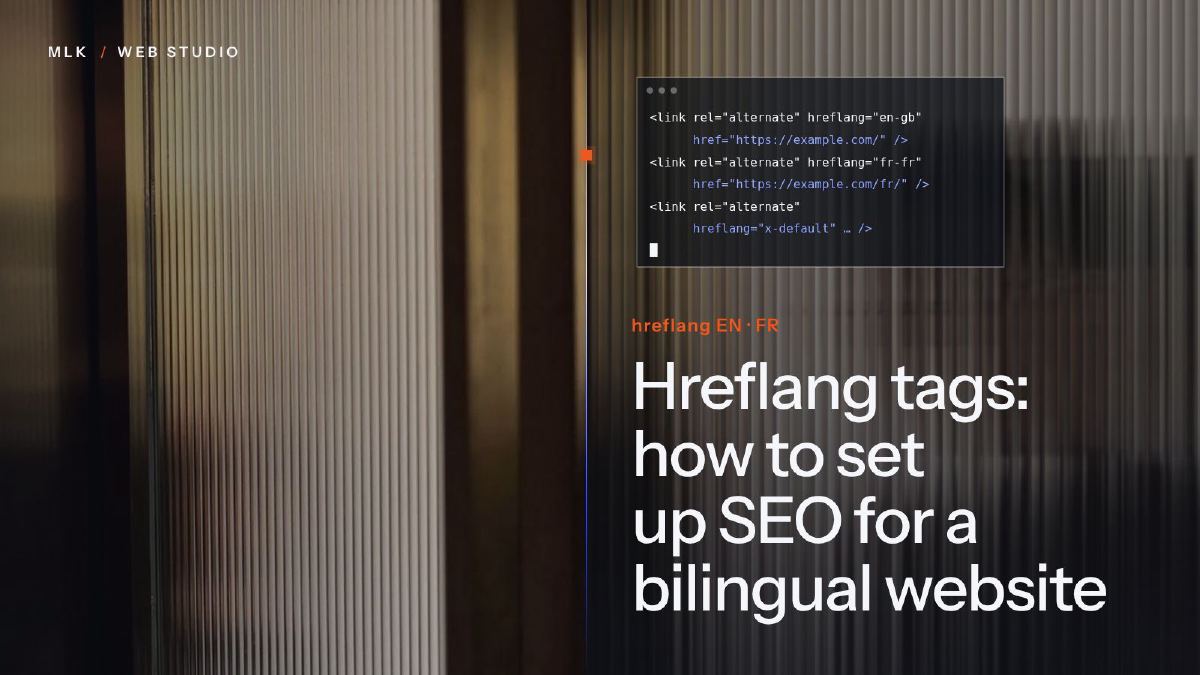 Hreflang tags: how to set up SEO for a bilingual website
Hreflang tags tell Google which language version of a page to show. How to set them up on a bilingual site, check them and avoid the mistakes that break them.