GEO vs SEO: what really changes when customers ask AI instead of Google
GEO vs SEO: what is genuinely new when customers ask ChatGPT or Google's AI, what is still plain SEO, and which GEO sales pitches a small business can ignore.
GEO (generative engine optimisation) is mostly SEO under a new name: AI assistants quote pages they can crawl, understand and see confirmed elsewhere, and Google’s own guide of May 2026 says optimising for its AI features is still SEO. Three things are genuinely new: more crawlers to let in, mentions on other sites that weigh more, and measurement with gaps. Check those, then keep working the channels that already bring you clients.
GEO, short for generative engine optimisation, is the work of getting your business used as a source, and named, in the answers that AI assistants write: ChatGPT, Claude, Perplexity, Gemini and Google’s AI Overviews. The shift behind it is real. AI Overviews have appeared above Google’s results in the UK since August 2024, and in July 2026 Google said its AI Mode had passed 1 billion monthly users.
My view on GEO vs SEO fits in one line: most of GEO is SEO you should be doing anyway, and the genuinely new part is small enough to check in an afternoon.
This is not a dismissal of AI. I work with Claude, I use AI deep research to find what customers complain about and which keywords keep coming back, and since AI arrived my delivery times have shrunk. But every new acronym brings new packages to sell, and small teams fall for them easily. For the full method, see my complete guide to generative engine optimisation.
What GEO means, and where the word comes from
GEO is the practice of shaping your pages and your reputation so that AI-generated answers use them as sources. The term comes from a research paper by a team from Princeton University, Georgia Tech, the Allen Institute for AI and IIT Delhi, first posted in November 2023 and presented at the KDD conference in August 2024 (the paper on arXiv). On a benchmark of test questions they built, the authors reported that some ways of rewriting a source raised its visibility in generative answers by up to 40%, and that what worked varied from one field to another.
That is serious research, but it measured visibility on a test bench, not in your customers’ searches, so treat the 40% as a lab result rather than a promise. Other acronyms circulate for the same idea: AEO for answer engine optimisation, AIO for AI optimisation. Whatever the label, the goal is the same, and the work sits next to SEO rather than replacing it.
GEO vs SEO at a glance
| SEO | GEO (AI answers) | Same or new? | |
|---|---|---|---|
| The goal | A high position and a click | Being used as a source and named in the answer | New angle, same groundwork |
| Who reads your pages | Googlebot and Bingbot | Also OAI-SearchBot, Claude-SearchBot and PerplexityBot | New: check they can get in |
| What gets you chosen | Clear pages, links, reviews | Clear pages and mentions on other sites | Mostly the same |
| Special files and markup | Sitemap, structured data | llms.txt and “AI schema”, which Google Search ignores | Not needed |
| Measurement | Clicks, queries and positions | Impressions, citations and manual checks | New gaps |
What stays the same: the SEO foundations
In May 2026, Google published a guide to optimising for its generative AI features, and its message is blunt: optimising for AI search on Google is still SEO, because those features run on the same ranking and quality systems as the normal results (Google Search Central). To be eligible as a link in AI Overviews or AI Mode, a page only has to be indexed and allowed to show a snippet. There is no form, no special file and nothing to submit.
The other assistants work on the same principle: when a question needs current or local information, they search the web and write the answer from what they find. So the foundations carry over:
- Pages that search engines can read and index. A page that no crawler has visited cannot be quoted.
- One clear page per service. For one client with several websites, the site offering a long list of different services went nowhere, because it was too broad. The one that ranked sells a few very specific services. Ask an assistant for a boiler engineer in Croydon who does landlord gas safety certificates, and a business with a page for exactly that stands a far better chance of being named than one with a catch-all services page.
- The answer in the first lines. A heading in your customers’ words, then two or three sentences that answer it.
- A reputation outside your site. Reviews, directories and press have always counted in SEO. AI answers seem to lean on them even more, as you will see below.
So the work does not split in two. My small business SEO guide covers each of these foundations, and every hour spent on them serves Google and the assistants at once.
What genuinely changes when customers ask an AI
Three things are new. None of them needs a new agency, but each deserves a check.
More crawlers at the door
For years, Googlebot was the visitor that mattered most to a small site. Now each assistant sends its own crawlers, and most keep search and training apart. OpenAI runs OAI-SearchBot for ChatGPT search and GPTBot for training (OpenAI’s crawler documentation). Anthropic runs Claude-SearchBot and ClaudeBot, and Perplexity runs PerplexityBot. Block a search crawler and you can drop out of that assistant’s answers; block a training crawler and you only stay out of future models.
Google is the exception: AI Overviews draw on the normal search index, and Google-Extended, its robots.txt token for AI, only covers Gemini’s training and grounding. GPTBot, ClaudeBot and PerplexityBot also differ from Googlebot in one technical detail: they do not run JavaScript, so a page whose text only appears after a script runs can look empty to them. My guide to robots.txt for AI crawlers lists which bots to allow.
Being named counts more than being clicked
In SEO, the prize is the click. In an AI answer, the prize is often your name, because fewer people click at all. In a 2025 study of US users, Pew Research found that people clicked a traditional result in 8% of visits when Google showed an AI summary, against 15% without one, and clicked a link inside the summary in 1% of visits.
What other sites say about you seems to weigh heavily in who gets named. In an Ahrefs study of 75,000 brands, the number of web pages mentioning a brand was the factor most closely linked to visibility in AI Overviews, with a correlation of 0.664, ahead of links using the brand name and searches for it. A correlation does not prove cause, but in my view it moves your Google Business Profile, genuine reviews, trade directories and local press up the list, level with your own pages.
Measurement with gaps
SEO comes with decent free measurement: Search Console shows your clicks, queries and positions. AI search does not, yet:
- Google’s generative AI report in Search Console, open to all sites since 31 August 2026, shows impressions only, with no clicks and no queries (Google’s announcement).
- The AI Assistant channel added to GA4 in May 2026 counts visits from assistants such as ChatGPT, but not from AI Overviews or AI Mode, which arrive as ordinary organic traffic from Google.
- Bing Webmaster Tools shows how often Copilot and Bing’s AI summaries cite your pages, and the search queries the AI ran before citing them, but no clicks.
- ChatGPT tags its links with
utm_source=chatgpt.com, yet from 9 October 2026 many ChatGPT visits arrived without the tag or a referrer and landed in GA4’s Direct channel.
I already use Microsoft Clarity to see where visitors engage and what makes them leave, and it now sorts visits from ChatGPT, Claude, Copilot, Gemini and Perplexity into dedicated AI channels. For the rest, nothing replaces asking the assistants your customers’ questions yourself, once a month. My tutorial on how to check your AI visibility gives the method.
The GEO tactics I would not pay for
Some of what is sold as GEO is harmless, some is wasted money, and one part can hurt you:
- An llms.txt file. Proposed in September 2024, it is a text file that summarises a site for language models. No major AI provider has confirmed that it reads one, and Google Search ignores it. Keeping one does no harm; paying for one is another matter. My article on llms.txt explains who might read it.
- “AI schema”. Structured data still helps Google read your name, address and opening hours, but Google says its AI features need no special schema. In a test Ahrefs published in May 2026, adding JSON-LD to 1,885 pages, compared with 4,000 pages left alone, brought no meaningful rise in AI citations. My guide to schema markup lists the types still worth adding.
- Pages cut into chunks or rewritten for AI. Google’s guide lists both as unnecessary. Write for your customer: the assistant reads the same page.
- Guaranteed citations. Nobody controls what an assistant answers, and the answer to the same question changes from one day to the next. A guarantee is a sales line.
- Planted mentions. Fake reviews, paid forum posts and made-up “best of” lists. Google’s guide tackles inauthentic mentions in its section on AI search myths, and its spam policies already cover content mass-produced to manipulate rankings. This is the part that can hurt you.
Before you buy a GEO package
If I hold one belief about marketing, it is this: new shiny tools and practices are easy to fall for, and results come from focusing on the channels you already run. GEO is the newest shiny object. My own clients come from referrals, cold emails and SEO, in that order, and I would not put any of them on hold for an acronym. I explain the trap in more detail in my article on shiny object syndrome.
If someone offers you a GEO package anyway, ask four questions before you sign:
- What will you change that good SEO does not already cover?
- What will you measure, and with which tool, given that Google reports AI impressions only?
- Do you promise citations? If the answer is yes, walk away.
- Will you write down what to expect, and by when?
The last question comes from experience. A client once refused to pay me after six months because the SEO results were not there yet. The lesson I took from it: put expectations in writing before any work starts. Any GEO seller should do the same for you.
What I would do this month instead
- In Search Console, inspect your five most important pages, and fix any that are not indexed or carry a
noindexornosnippetyou did not choose. - Open yourdomain.co.uk/robots.txt and check that OAI-SearchBot, Claude-SearchBot and PerplexityBot are not blocked, then check Cloudflare if you use it.
- Give each service its own page, with the answer in the first lines.
- Complete your Google Business Profile and ask your recent customers for a genuine review.
- Ask ChatGPT, Claude, Perplexity and Gemini your customers’ five most common questions, note which businesses they name, and repeat next month with the same wording.
- Keep running the channel that already brings you clients.
None of this needs a GEO package. If you would rather hand the groundwork over, it is the heart of my SEO service.
Frequently asked questions
Is GEO replacing SEO?
What is the difference between GEO and AEO?
Does ranking first on Google mean ChatGPT will recommend me?
Can I stay out of Google's AI Overviews and keep my normal rankings?
How long does GEO take to work?
Joana MehouWeb designer, SEO and cold emailing specialist
Joana Mehou has been building websites since the age of eleven and founded MLK Web Studio in 2021, between London and Paris: websites, SEO, cold emailing and automation for small businesses in the UK and France, with honest advice, including when you do not need to hire anyone.
More about the studioThe searches your clients type, the pages that answer them, the technical work behind.
 AI visibility: check if ChatGPT, Gemini and Perplexity mention your business
Check your AI visibility for free: ten prompts, a spreadsheet and a monthly test in ChatGPT, Gemini and Perplexity, then the paid trackers and what to fix.
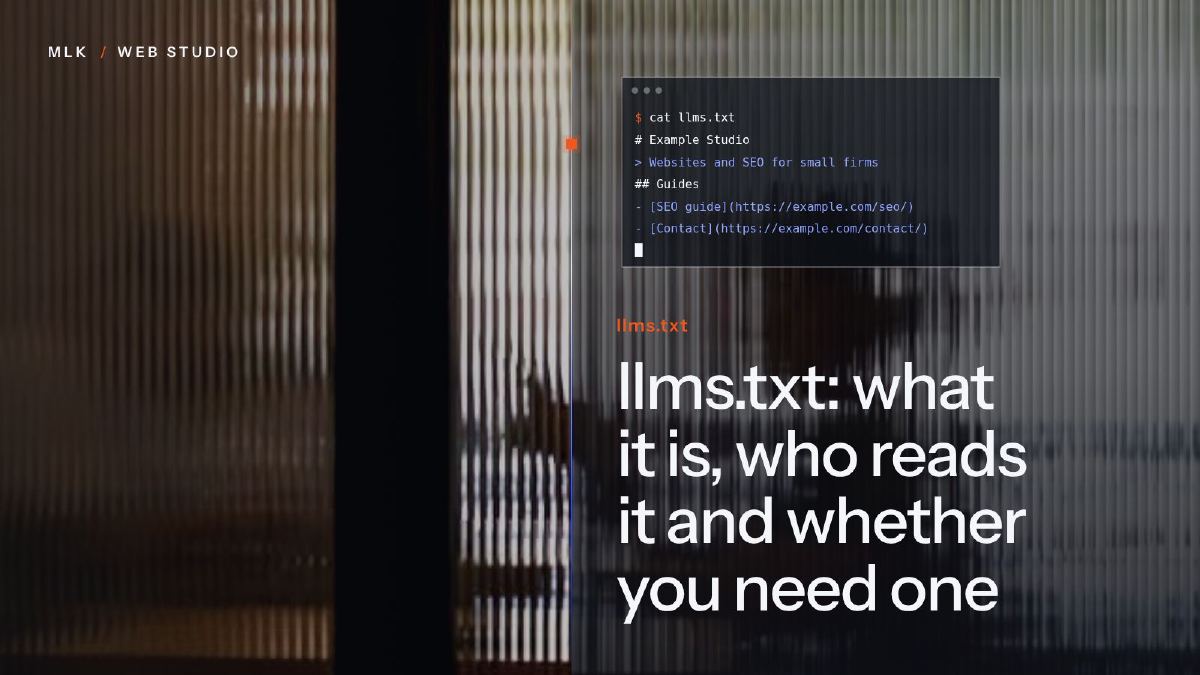 llms.txt: what it is, who reads it and whether you need one
llms.txt is a Markdown file that summarises your site for AI tools. Who really reads it in 2026, whether you need one and how to add it in ten minutes.
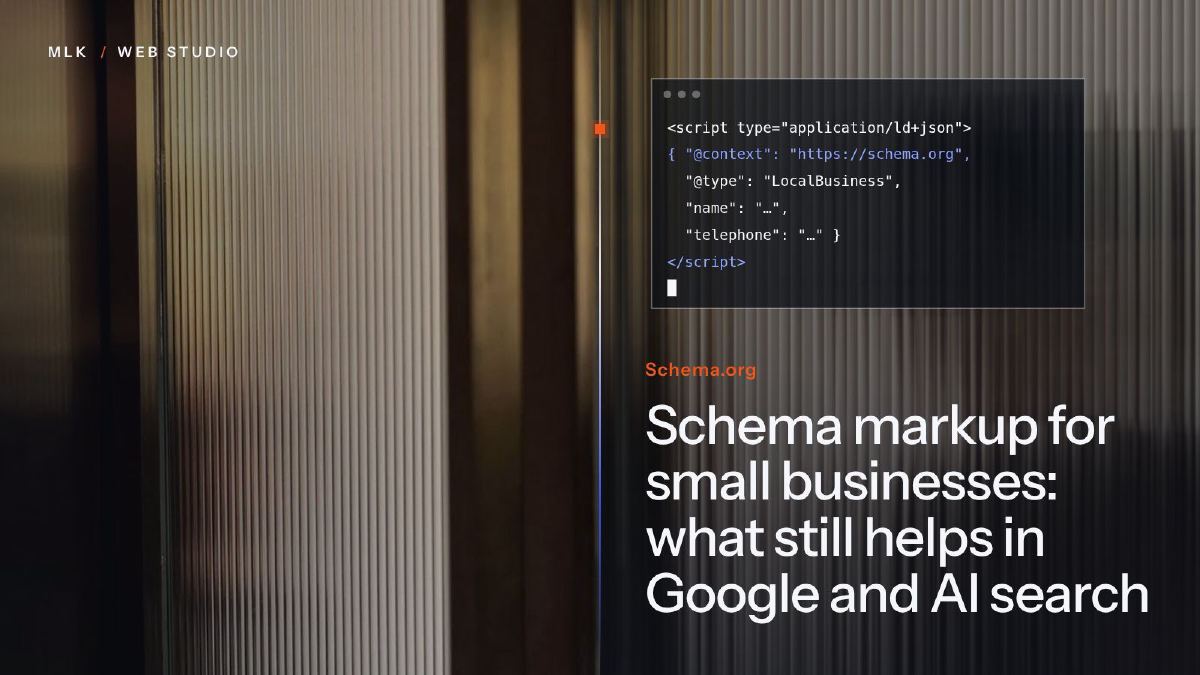 Schema markup for small businesses: what still helps in Google and AI search
Schema markup in 2026: the types that still help a small business in Google, what AI search really does with them, and JSON-LD code to copy and test.